| Chiapas - Attractions | ||||
| Back to Catalog | Home | Attractions | Hotels | Transport |
PALENQUE
Considered by many to be
Mexico's most beautiful and alluring archaeological site,
Palenque is reached from Villahermosa via highway
186/199. The trip takes about90 minute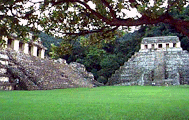 s (140 km). The ruins are about 8
km from the dusty and rather unappealing city of
Palenque. Here you'11 find the area's only lodging, plus
numerous shops and inexpensive restaurants (La Selva, Los
Pinos, El Maya are recommended). Since Palenque is a
major archaeological attraction, tour buses seem to be
constantly plying the city’s streets and foreign
tourists are everywhere.
s (140 km). The ruins are about 8
km from the dusty and rather unappealing city of
Palenque. Here you'11 find the area's only lodging, plus
numerous shops and inexpensive restaurants (La Selva, Los
Pinos, El Maya are recommended). Since Palenque is a
major archaeological attraction, tour buses seem to be
constantly plying the city’s streets and foreign
tourists are everywhere.
THE PALENQUE SITE
Period………………………………Classic
Culture……………………………..Mayan
Lifespan……………………………100-900
A. D.
Everything about Palenque fascinates. It mesmerizes visitors with its primordial jungle setting, delicate, airy construction and intimate scale.
In its heyday, Palenque was a sprawling religious center that spanned nearly 25 square miles. Only about one-half mile has been excavated, revealing what many consider to be the "architectural apogee" of western Mayan civilization. Numerous inscribed stone slabs, intricate bas-relief sculpture, inlaid masks and other adornments give Palenque a feeling of enchantment and sanctity.
The 75-foot-high Temple of the Inscriptions contains one of the only crypts found inside a pyramid in Mexico. The Tomb of Pakal, a
Mayan ruler of the seventh century, revealed jewels, masks, jade ornaments, wall carvings and other exquisite artifacts. ...Take a swim suit for nearby cenote swimming.
By Word of Mouth
At the time of the Conquest a young mother, Maria de Angulo traveled miles from her town in Guatemala to Chiapa de Corzo to visit a Shaman. Her son was deathly ill. The shaman said that the child was a victim of evil eye. He then prepared an ointment of wild leaves, "candox" and duck egg that he rubbed on the child’s body. From then on the child started recovering, and by the third day of treatment was completely healed.
So happy was Maria that she could not contain herself. She went out into the street dancing and skipping while carrying her son on her shoulder. She tossed oranges coins and squash to the people of the village. At the community joined here in the dancing.
From that day on the "Parachico" Dance (for Child Dance) has been celebrated in Chiapa de Corzo from the 16th –23rd of January.
-From Juan Antonio Díaz Díaz
PALENQUE SAN CRISTÓBAL CORRIDOR
Most tours continue south along highway 199/190 toward the Chiapas highlands and the city of San Cristóbal. Road conditions are poor, but the drive is one of Mexico's most scenic. Without stops, the drive is a good seven hours long. You’ll pass native villages and hillsides carved from the dense jungle and planted with maize. The drive from Palenque is 210 km Between Palenque and Ocosingo (see map) is the beautiful 100-foot waterfall at Misol-Ha (20 km south of Palenque), and the breathtaking Agua Azul Natural Reserve (60 km south of Palenque). The reserve is a stunningly beautiful series of pools, ponds, and rivers bordered by tropical flowers and exotic dense jungle. The water is a deep blue and is ideal for swimming.
Fourteen km east of Ocosingo are the Mayan ruins of Toniná. The site has several large structures carved into a sloping hillside. Recent excavations have unveiled a large city-state that thrived between the years 500-800 A.D.
San Cristóbal de las casas
As you climb to the town of San Cristóbal, the climate changes from tropical to cooler mountain temperatures, and lush jungle is supplanted by pine forests. The sturdy colonial village of San Cristóbal de las Casas climbs the hills of a valley of pine forest and orchids in Chiapas' central high_ lands. It is the center of one of Mexico’s most authentically indigenous regions. Founded in 1528, San Cristóbal was named after its first Bishop, Bartolomé de la Casas. A fervent protector of America’s indigenous peoples, his efforts could do little to stop the enslavement of the conquered Chiapan Indians, whose labor became the foundation of the area’s agrarian economy.
SAN CRISTÓBAL DE LAS CASAS
Tourist Office: Tel. 52-967-80414
For most of the colonial era, San Cristóbal and Chiapas were a province of Guatemala. For two years following Mexican independence in 1821, it was allied with neither Mexico nor Guatemala. In 1824 it officially joined Mexico. It served as the state's capital until 1892, at which point the capital was moved to Tuxtla-Gutiérrez. Time stood still in San Cristóbal until the 1950's when a paved road reconnected the city to the rest of Mexico.
Today San Cristóbal
(population 60,000) is a very Spanish-looking town with a
very Indian heart. It is a city of cobblestone lanes, red
tile roofs and opulent churches and mansions. Long,
straight streets ramble up and down several rolling hills
that spread outward from the city's main plaza. It is
actually a series of barrios (neighborhoods)
that trace their roots to pre Conquest days. Each barrio
has its special magic in various dress, traditions
and vocations, giving the city a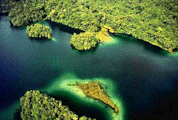 colorful quiltlike quality.
The city's cool mountain air (altitude is nearly 7,000 feet / 2, 1 00 meters) is invigorating, and the smell of wood smoke wafts from chimneys. Just outside of town are countless villages where no fewer than 10 different dialects are spoken. Good views of the city are had from two bills on the city’s outskirts (Cerro San Cristóbal and Cerro Guadalupe). Each is topped by a small Spanish colonial chapel.
The city has some fascinating festivals, including Semana Santa (Easter), Feria de la Primavera y de la Paz (Spring fair), Feast of San Cristóbal (July 1725), Day of the Dead (Nov. 1-2), and Navidad (Christmas).
L O C A L T O U R O P E R A T O R S
Anfritiones Turísticos
Tel. (967)83145
Posetur Tel. (967)80621
Pro-Natura Tel. (967)84069
Viajes Blanquita Tel/Fax.(967)80380
Viajes Pakal Tel. (967)82818 Fax.82819
Begin your excursion in the small downtown area; all attractions can be explored on foot.
- PLAZA 31 DE MARZO: Head first to the city's main square, surrounded by 16th century buildings. Some are former homes of the city’s Spanish conquerors. This is the city's social center and draws visitors and natives together. On the square's north side is the 17th century Cathedral, noted for its elaborate gold leaf interior and altar, and distinctly indigenous flavor. To the west is the Palacio Municipal, a 19th century neo-classic building with interior courtyard. To the south is the square's oldest structure, the Casa de Diego Mazariegos (now the Santa Clara Hotel). This is one of Mexico's finest examples of 16th century Plateresque styling.
- TEMPLO DE SANTO DOMINGO: About four blocks north of the zócalo is this, the city's prettiest church. It was built between 1547-60. Its baroque façade is of soft pink-colored stone, while the interior is exuberantly decorated with gilt retablos. The attached Dominican monastery houses a good museum and an excellent shop (Sna Jolobil) with the region’s best display of hand-woven textiles. A few blocks further to the north is the city's colorful eight-block-long mercado. It is best visited in the morning or on Saturdays. Use discretion when snapping pictures.
- MUSEO de Arqueológia, Etnografía, Historia y Arte: Located next to the Templo de Santo Domingo, this museum deals mostly with the history of San Cristóbal (signs in Spanish only).
- TEMPLO DEL CARMEN: Dating to 11597, and formerly part of a nunnery, this mustard-colored church is next door to the city's Casa de la Cultura. Its unusual bell tower dates to 1680.
- CENTRO DE ESTUDIOS CIENTIFICOS, Na-Bolom: This handsome colonial-style building on the out skirts of town houses the city’s most important cultural institute. Founded by Danishborn explorer and archaeologist Franz Bloom and his Swiss sociologist wife Trudy, the center is dedicated to the ethnological and ecological study of the region. The center has taken a keen interest in preserving the tropical rainforest, Lacandon region, and its Mayan-descended tribe of a few hundred Indians. Franz Bloom (who died in 1963) directed the excavations at Palenque in 1923. His wife lived here until her death in December, 1993 at the age of 92. The center has an excellent library, museum, and a cozy 12-room guest house (see below for details). Guided tours in English are offered Tues-Sun at 4:30pm.
San Cristóbal
Day Trips
L A G U N A S D E M O N T E B E L L O
Lagunas de Montebello is 155 km or a 2.5 hour drive from San Cristóbal. It is a 2,400-acre national park on Mexico's southern border with Guatemala. Its 60- odd lakes are each a unique color due to mineral oxidation. The park is wonderful for wildlife viewing and hiking. Fullday tours operate from San Cristóbal. Along the way you’ll pass through Comitán, a pretty village of cobbled lanes and pastel hued houses. It was founded in 1527.
S A N J U A N C H A M U L A & Z I N A C A N T Á N
A few miles outside of San Cristóbal are two of the state's most interesting Indian villages, San Juan de Chamula and Zinacantán. Deeply religious and more of pre-Con-quest than modern times, these fascinating, tradicional villages are home to the Tzotzil and Tzeltal peoples. Both have markets on Sundays. Escorted tours are the only way to visit these towns. (See Local Tour Operators list on previous page.)
A R C H A E O L O G I C A L S I T E S
For those itching to see
more Mayan ruins, the state has three other sites of
importance. Toniná is located 14 km east of
Ocosingo. It features several large stone buildings
terraced into the hillside and engulfed by the jungle. Yaxchilán
is an impressive ceremonial center along the shore of
the Usumacinta River. Nearby Bonampak is renowned
for its colorful (although now fading) frescoes dating to
the sixth century. Both Bonampak and Yax-chilán are
southeast of Palenque nearly 180 km They are best reached
through an escorted 2-night tour of both sites (arranged
by several San Cristóbal travel agencies; cost is around
$90 U.S. per person).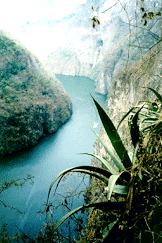
T R I U N F O B I O S P H E R E R E S E R V E
Near the southern tip of Mexico, outside the town of Tapachula, lies the Triunfo Biosphere Reserve. Named after an inactive volcano, El Triunfo (The Triumph), this is a comparatively small reserve that protects what may be the most spectacular misty forest remaining in North America.
It's not easy to reach the Triunfo Reserve. After a brief car ride from the village of Mapastepec to the outskirts of the reserve, you begin a 22-km hike to your campsite, gradually leaving the 20th century behind. As you make your way through the reserve, you’ll camp beside sparkling clear mountain streams. Bed down overlooking a waterfall, all the while surrounded by the luxurious vegetation of 30-foot ferns and 100-foot trees, wrapped in the cool clouds and mist that hover near the summit of the volcano.
Over 300 species of birds make their home here, several of them found only in this region. One of the most spectacular is the brightly plumed quetzal, which figured so prominently in the Tolteca and Aztec cultures.
Oddly enough, even with the quetzal's brilliant green, white and vermillion plumage, they’re hard to spot as they perch among the vines and tree ferns.
You will also see plenty of hummingbirds, flycatchers, forest falcons and manakins. You may even catch a glimpse of the azure-rumped tanager, a brilliant blue and green bird that's fairly common in this forest and in similar habitats in neighboring Guatemala. But these are very likely the only places in the world that it exists.
Tuxtla-Gutiérrez
Route 190 connects San Cristóbal to the Chiapas State capital city of Tuxtla Gutiérrez. The two-hour/82 km trip is strikingly scenic, over a good two-lane highway.
Tuxtla-Gutiérrez lies at the heart of the State's thriving coffee plantation region. lt is also where Mexico’s jovial Marimba music originated. The city, population 525,000, mostly serves visitors as a gateway to the region. However, it does have a few worthwhile attractions, including one of Latin America's finest zoos (Miguel Alvarez del Toro). Known as Zoomat, this ecological park is home to over 100 species of free-roaming Chiapan fauna. The Parque Madero is a fine archaeological museum and botanical garden. It houses one of the largest collections of Mayan artifacts anywhere in the world.
One of Mexico's most breathtaking natural wonders lies a short 18 km north of Tuxtla. The Cañón del Sumidero is a gaping canyon with 3,300-foot-tall vertical stone walls that stretch for 15 kilometers. Formed by the Río Grijalva, the canyon is replete with exotic wildlife and waterfowl. Admire the canyon from several viewpoints or take an exhilarating two-hour boat ride.
Boat trips depart from a pier in Chiapa de Corzo, an interesting riverside colonial-era village. The city has been continuously occupied since around 1500 B.C. This was the original site for the first Spanish settlement in the area. It has some interesting attractions including a lacquer ware museum (Museo de la Laca), a bizarre Mozarabic style fountain (built in 1562), and Gothic-style 16th century Iglesia de Santo Domingo church.