| Tlaxcala - Attractions | ||||
| Back to Catalog | Home | Attractions | Hotels | Transport |
TLAXCALA CITY
This handsome city of
30,000 inhabitants rests in a small valley surrounded by
low hills and well-tended pasture and farm lands. Founded
in 1525 along the shore of a small winding river the city
was laid out in classic grid fashion. Narrow cobbled
streets radiate from the city’s shady main square.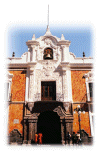
Many downtown buildings date back to the 16th and 17th century, and are well preserved, sturdy examples of colonial styling. The architectural influence of nearby Puebla is evident in many civic and religious buildings, some of which are adorned with tile and painted in soft ocher and sepia. Several scenic viewpoints above the City capture Tlaxcala’s tranquility with glimpses of towering snow-capped volcanoes looming in the distance.
PLAZA DE LA CONSTITUCION:
The city’s main plaza is one of Mexico’s prettiest. Several tiled fountains, a central bandstand, and well-tended gardens invite strollers and people-watchers at all hours. It is bordered on all sides by colonial-era palaces and mansions shaded by thou-sand-year-old laurel trees. A series of portico arches spans the east side of the square, home to several outdoor cafes.
To the north is the stately Palacio de Gobierno which dates back to 1545. Its exterior is done in patterned brick, with a gleaming white plaster facade and small balconies. Inside are a series of exuberant wall murals depicting Tlaxcalan history.
Next door is the Palacio Municipal with its Moorish-style second floor arches. Just off the square toward the northwest is the Church of San José, noted for its brick and Talavera tile exterior, set off by ornate white stucco decorative motifs.
Back on the main square, the western side houses two 16th century palaces, the Palacio de Justicia (1528) and the Palacio Legislativo (1551). The square’s southern flank is dominated by one of the state’s finest colonial-style hotels, Posada de San Francisco, described in Lodging, PBC-6.
PLAZA XICOTENCATL: This diminutive square positioned diagonally from the Plaza de la Constitution features a large statue of Tlaxcalan chief Xicoténcatl. After helping the Spaniards conquer the Aztecs, he was hanged in 1521 for disobedience and became a martyr the Tlaxcalan people.
EX-CONVENTO DE SAN FRANCISCO: Dating back to 1526 when Tlaxcala
was named the first diocese of New Spain, this austere
Franciscan ex-convent is located just above the Plaza
Xicoténcatl up a sloping cobbled pathway. It was built
between 1526-40, and is noted for its beautiful carved
cedar ceiling with geometric "mosarabic"
styling.
A chapel off to one side contains two items of great historic importance: a large stone baptismal font (where Tlaxcala’s four chieftains were converted to Christianity) and a carved pulpit carrying the date of 1520 and a Spanish inscription reading, "Here the Holy Gospel had its beginning in this New Word."
Next door is the Museo Regional, housing jumbled chronological display of Tlaxcalan history. From the courtyard facing the Museo there is an excellent view of the city’s 19th century Plaza de Toros (bullring), and a massive bell tower dating back to the late 16th century. Note: The State is known throughout Mexico for producing Mexico’s fiercest bulls.
CAPILLA ABIERTA: Just below the Ex-convento is this open-air Gothic-style chapel, believed to be the oldest in the Western Hemisphere. Here Cortés attended Mass prior to marching with his Tlaxcalan allies
to conquer the Aztec empire in 1521.
MUSEO DE ARTES Y TRADICIONES DE TLAXCALA: This "living history"museum displays masks, costumes, weavings and other Tlaxcalan artistic traditions. Artisans are at work here on weekends, and handicraft items are for sale.
SANTURARIO DE NUESTRA SEÑORA DE OCOTLAN: Located on a hill overlooking Tlaxcala’s city center and surrounding volcanic peaks, this splendid example of Puebla/Tlaxcalan styling is one of Mexico’s most sacred religious treasures. Local legend explains the sanctuary was built on the site where the Virgin appeared in 1541, ending a long drought by making water flow from this very spot. The sanctuary, dating back to 1670, is renowned for its intricate, ornate white plaster facade set off by oval shaped red tiles. Two gleaming white bell towers with lacy plaster carvings reach skyward. Inside stands a statue of the Virgin backed by the main altar, a riot of gold leaf ornamentation. Behind the altar is the Camarín, an octagonal-shaped dressing room decorated by a local artist who spent 25 years (1715-40) carving gilded wood figures on every inch of wall and ceiling space. A must see!
COLONIAL VILLAGES
As one of Mexico’s earliest seats of religious authority, Tlaxcala State is home to some of Mexico’s oldest temples, churches, and sanctuaries. Dozens of small villages stretch across the state, including Tepeyanco (famous for its crumbling 16th century monastery), Huamantla (renowned for its colorful August festival with flower and sawdust tapestries and running of the bulls), Santa María Atlihuetzía (with its 100-foot-tall waterfall and 16th century Franciscan monastery), San Miguel del Milagro (home to Xicotencatl’s palace and an open-air chapel built atop its ruins), and Tlaxco.
CENTRO VACACIONAL LA TRINIDAD: This multi-purpose recreational center, located a few short miles from Tlaxcala City, is housed in a former British textile mill dating back to the 1880’s. Red brick Victorian-era warehouses and workers quarters have been masterfully converted to house a small hotel, theree
olympic-size swimming pools (one indoor), ponds with rowboat rentals, and an enormous park for camping and picnics. Take note of the stately Victorian chapel near the entrance.
LA MALINCHE: A dormant volcano that dominates Tlaxcala’s eastern horizon, La Malinche reaches 4,450 meters (14,596 feet). At its base is one of Mexico’s best national parks, popular for hiking and picnics. Summit climbs are possible, with trails beginning near the Centro Vacacional La Malinche. The park is located 30 km. southeast of Tlaxcala.
ARCHAEOLOGICAL SITES
CACAXTLA
Location………….35 km. northwest of
Puebla
Period…………….late Classic
Culture……………Olmeca/Xicalanca
Lifespan…………..650-900 A.D.
This fortified ceremonial center provided modern day archaeologists with one of their greatest finds when, in 1974, looters unearthed a vibrant colored mural from beneath some abandoned hilltop ruins. The main attractions here are some of the most brilliant and best preserved pre-Hispanic murals yet discovered in Mesoamerica. Two large groups of murals depict battles in the eighth century when the city’s inhabitants fought for control of Mexico’s Central Plateau following the fall of Teotihuacán. The ceremonial and palace complex features several patios, residences and religious and civic buildings.
XOCHITECATL
Location……………35 km. northwest of
Puebla
Period………………Pre-Classic/early Classic
Culture……………...Olmec-Xicalanca
Lifespan…………….1,000 B.C.- 950 A.D.
Lying just a stones’ throw from Cacaxtla on the crest of a nearby hill, Xochitécatl was only opened to the public in November, 1994. Xicoténcatl (meaning "family of flowers" in Nahuatl) pre dates Cacaxtla, and served as trade and ceremonial center that had contacts with both Mexico’s gulf coast and Central Plateau. The hilltop site overlooks the fertile fields of Tlaxcala and Puebla States, with towering snow capped volcanoes as a backdrop. The site exhibits four main structures, including Building 1, a large rectangular pyramid that faces a courtyard with two stone monoliths with detailed carvings, and burial sites containing infant remains.